Picture the scene: a young debutante has been accidentally compromised. She was stranded in a cottage overnight with a handsome duke, caught in the bedroom with a baron, seen kissing a man to whom she wasn’t betrothed, or— fill in the blank with any number of compromising situations. If you’re a regular reader of Regency romance, you’ve probably read many books that make use of the “we must marry each other because she’s been accidentally compromised” trope. It is, to be honest, one of my favorite historical romance tropes, because it lets you skip over weeks or months of courtship and betrothal and get straight to the marriage of convenience.
Anyway, the young lady in your novel has been compromised. The only way to solve this problem is for the debutante to marry the duke/baron/whoever IMMEDIATELY! And you know what that means: either they have to run off to Gretna Green or they must get a Special License from the Archbishop of Canterbury so that they can get married without waiting weeks to call the banns. Right?
Actually, no. There was a third way to get married in a hurry: obtaining a common license from the local bishop. This was probably what many members of the gentry and nobility did anyway, to avoid the public nature of calling the banns. A common license allowed a couple to get married in their parish church between the hours of 8 a.m. and noon, without waiting weeks for the banns.
Some online sources say that you had to wait a week or more between getting the license and using it, but this seems not to be accurate. (At least, I’ve not seen supporting evidence for the claim.) Marriages during the Regency were governed by the 1753 Clandestine Marriage Act, also known as the Hardwicke Marriage Act. You can read the text of the Act here, and Sharon Latham discusses its requirements in more detail here. Notice that the 1753 Act says nothing about a waiting period before one can use a common license!
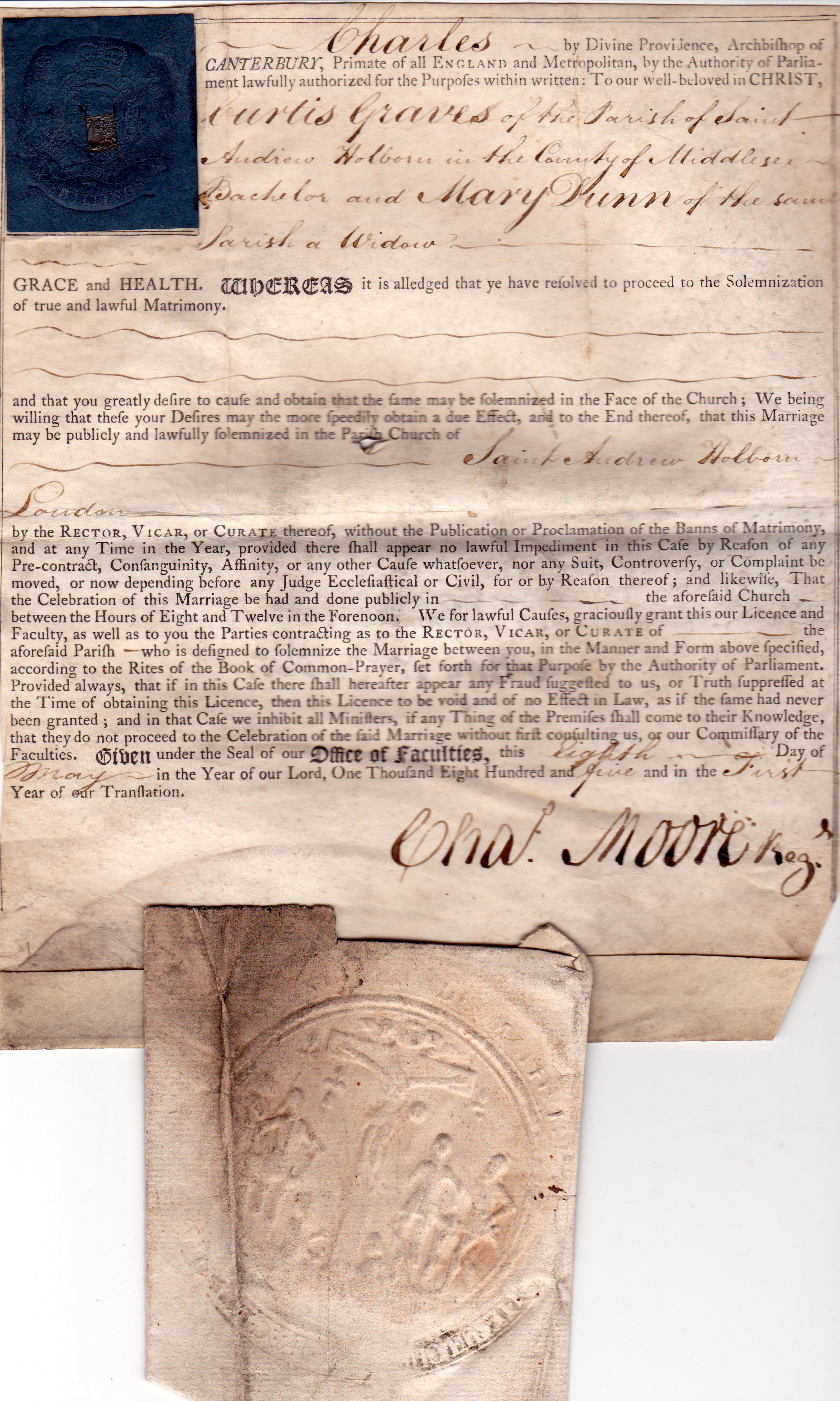
In fact, Louise Allen’s blog, Jane Austen’s London, provides an example of a common license signed on May 08 1805 and used on May 10, just two days later. While it’s true this license was signed by the Archbishop of Canterbury, we know it’s a common license because it says that the wedding must be in the parish church between the hours of 8 a.m. and noon.
So, if your debutante character has been compromised and must get married immediately, there’s no need to appeal to the Archbishop of Canterbury or visit Doctor’s Commons. Instead, the compromised couple can obtain a common license from the bishop presiding over either the bride or the groom’s parish. In theory, it might be possible to obtain a license early in the morning and be married before noon the same day. I doubt that often happened in real life, but sometimes the characters in our novels are in a rush!
This is great news for your characters, but it may be bad news for authors and readers who’ve grown accustomed to the use of Special Licenses. Take heart! There are still some situations in which a couple might want a Special License. For example, they would need a Special License if they wanted to be married at any time other than the morning, or if they wanted to be married at home, in a private ceremony. Remember, a parish church was a public place, and a noble wedding might draw a crowd of onlookers eager to watch the bride and groom exit the church. Some members of the nobility did prefer private marriages at home in order to avoid this kind of publicity.

 Anne Rollins Romance
Leave a comment