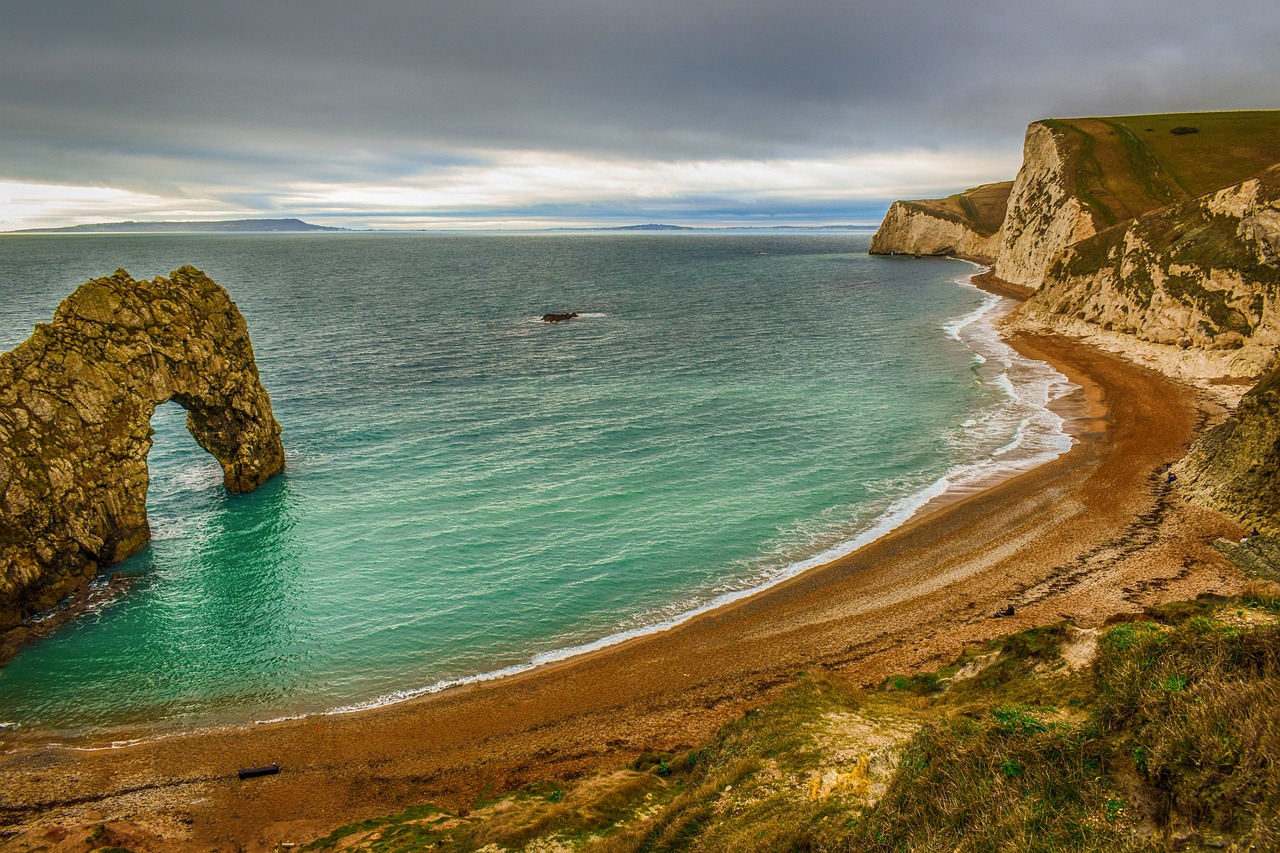
Different authors take different approaches to the settings of their historical romance. I generally prefer to invent fictional towns or villages so that I’m free to make up the details as needed. For example, “Castle Rock Cove” is loosely inspired by Lulworth Cove, but the surrounding towns are fictional.
So how do you come up with locations that sound plausible but aren’t real?
One tip is to take an existing place name and change it slightly. There is no town called “Caseton” in England, though there are places named “Carterton,” “Castleford,” and “Carshalton.”
Adding the suffix -ton can turn a common word into something that sounds like a plausible town. Similar word endings include -ford (refering to a river crossing), -ham, and -bury. Note, though, that each of these name endings comes from a different source, and some of them mean different things, so they are not interchangeable. If you’re really into history and lingustics, you may find it useful to read about the origins of English place names.
If you look over a list of English towns and villages, you’ll see more opportunities for place names. In the post on Threads that inspired this blog post, I talked about creating fictional market towns by adding the word “Market” or “Chipping” to an existing name. (By the way, this means that the name “Market Chipping,” from Howl’s Moving Castle, is redundant! I see what you did there, DWJ.) Adding one of those words to an existing name might create a plausible fictional location.
Threads poster Clairemilli (Claire Millington) suggested adding “upper,” “lower,” “east,” or west,” too. Place names using “North” and “South” can also be found in England, so that’s a possibility. If you don’t want your character to live in real-life “Durston,” maybe you can send them to fictional “Upper Durston.”
If you browse a list of English town names, you’ll see other possible words to add. Some refer to the size of the town: Great or Little. For example, Regency romance author Gail Eastwood has an entire series centered around the fictional town of Little Macclow. It’s also possible to change a name by adding Old or New. Keep in mind, though, that a village named “Little Placename” would probably be located near a larger town named “Great Placename,” or simply “Placename.” Similarly, if there’s a “New Placename” in your novel, that may imply the existence of “Old Placename.”
Other words found in town names refer to geographic places or structures, such as Green, Hill, Woods, Common, or Bridge. If you’ve ever studied the life of the Brontës, you may remember that some of the girls attended school at a village called “Cowan Bridge.” For another example, “Cliffe Common” is a hamlet in Yorkshire, located near a slightly larger village simply called “Cliffe.”
And don’t forget that some town names include “on” or “by.” Shakespeare came from real-life “Stratford-on-Avon.” In The Case at Castle Rock Cove, Willa Selwyn visited her cousin at fictional “Newell-on-Sea.”
Finally, some town and village names refer to a person in authority: Abbots Langley, Bishop’s Waltham, King’s Weston, Lyme Regis, etc. Those might give you some other ideas for creating fictional location names.

 Anne Rollins Romance
Leave a comment