[Note that this post has been revised to reflect new information. See also the follow-up post.]
The research for this post began when I was writing a proposal scene in one of my Regency romances. I wondered whether gentlemen in the Regency period went down on one knee when they proposed, as they sometimes do today. Many Regency romances depict this. For example, in Mary Balogh’s First Comes Marriage, Vanessa requests that Elliott propose properly, on one knee. But some sources I’ve read suggest that kneeling on one knee to propose might have developed later in the nineteenth century, or even in the earlier twentieth-century. While I’ve seen Victorian art or engravings depicting the on-one-knee proposal, I don’t think I’ve found art actually produced in the Regency that depicts a proposal that way only recently did I finally see of a kneeling proposal published in the Regency era. See the new find:

You can read more about that wood cut here. Or, read the rest of the original post below.
So what did marriage proposals look like in the nineteenth century? To find out, I searched the internet for paintings or drawings of proposal scenes. I discovered a whole genre of art depicting what I call “Regency proposals gone wrong.” Edmund Leighton has multiple proposal paintings depicting ambiguous or failed proposal scenes. For example, here’s “Yes or No?”

In the painting above, the answer to the question “Yes or no?” seems to be “No.” I’m neither a flower expert nor an art historian, but I believe the blue flowers in her hand are forget-me-nots, which leads me to speculate that she is remembering a different lover. In any case, she seems more interested in the flowers than in her suitor.
The same seems to be true in the painting below, which I’ve seen reprinted as “Love’s Appeal.”

In the painting above, the suitor seems anxious. But to me, the woman looks like she’s wishing he would leave her alone. Some of my followers suggested that she might be displaying the modesty or diffidence expected of a proper young lady in the time period. That would explain why her face is averted. In my opinion, though, her eyes say “OMG, no. I’m not that into you.” Either the anxious suitor is about to be rejected, or she’s going to accept him very reluctantly.
The next painting (again by Leighton) may be more ambiguous. On the one hand, the way the woman looks at the “work” (fiber art) in her hand rather than at the suitor could suggest lack of interest. On the other hand, her lowered eyes might simply indicate shyness or modesty. Either way, this is a far cry from the modern image of a happy bride-to-be staring deeply into her suitor’s eyes as she accepts.

The next two paintings are by Frederic Soulacroix, and they seem to go together. I’ve jokingly suggested that the woman in the first painting is thinking “Ugh, it’s too HOT for this! I need a cold drink!” But the painting that follows is one of the rare proposal paintings depicting an unambiguously happy couple. (Shout out to MJ Lloyd for finding the second of the two paintings!)
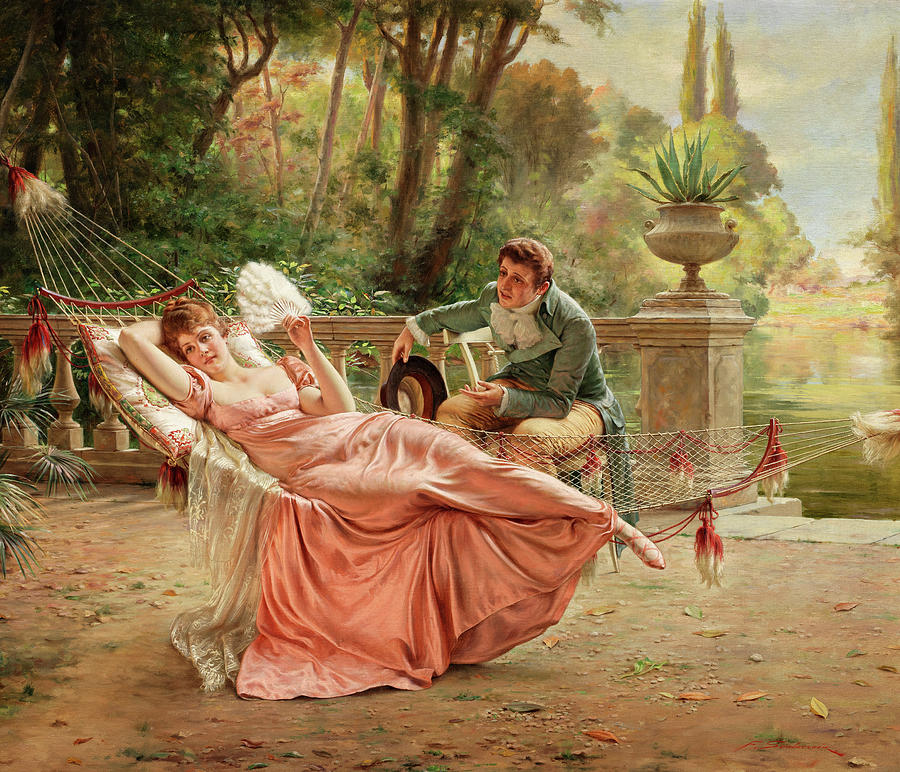
The painting below is the cutest, happiest nineteenth-century proposal scene I’ve yet to find in art. It’s also one of the few paintings in which the couple sit close together. In some other proposal scenes, you can see the woman physically trying to put space between herself and her suitor. We’ll see an example in the next image.
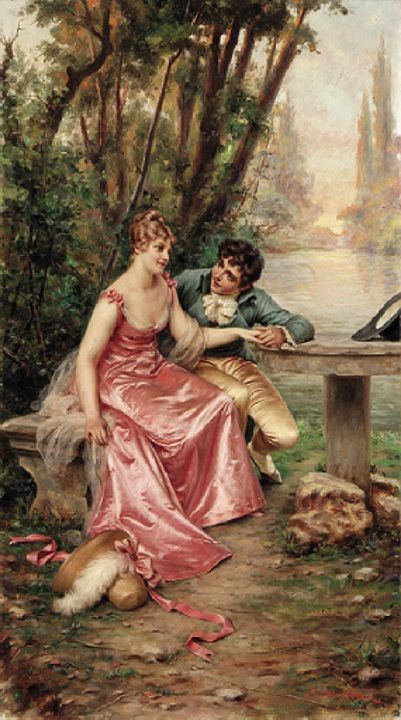
Note: I originally assumed that the painting below was also by Soulacroix, but it is actually by Vittorio Reggiani. See more here!
What caught my attention about the painting below was the way the woman leans away from her suitor, as if trying to get as physically distant from him as she can without falling off the sofa. She has a smile on her face, yes, but the body language all says “Ew, go away.”
The longer I looked at the painting below, the more questions I had. “What is going on with the dead animal under her feet?” Followed by “Why did he tie his cravat in a bow, as if he were a present? Does he think he’s God’s gift to women?” So many questions . . . (Note: I do not know the title of this painting. If you recognize it, feel free to shout it out in the comments.)

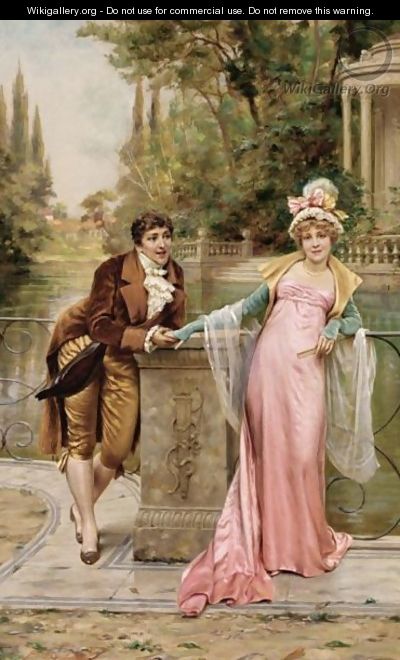
Soulacroix must have liked this subject, because he had other proposal paintings. In the next one, the woman looks away (as in many of these paintings), but I’m not sure that she’s unhappy about the proposal. While there are different ways of reading her expression, it seems to me like there’s a slight smile hinted here. Alternatively, she may be smiling anxiously.
My last image is a satirical print of a courting couple. Most (all?) of the other images in this post were done in the late nineteenth century, decades after the Regency ended. They thus represent a later interpretation of the time period I’m interested in. The print below, however, is actually from the Georgian era: 1805, to be precise.

If you have any sources that discuss marriage proposals in the Regency era, feel free to share them in the comments!


 Anne Rollins Romance
Leave a comment