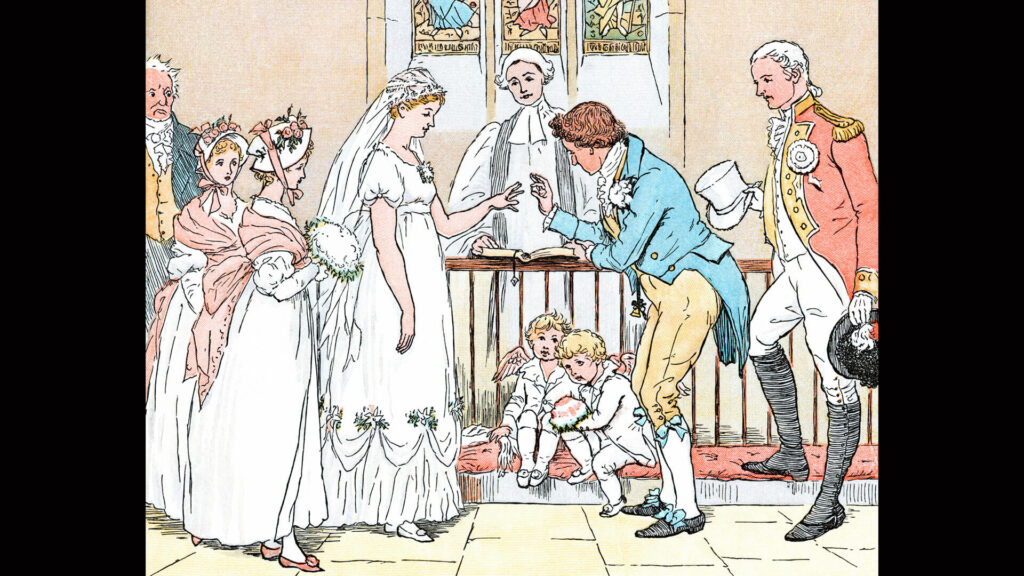
In Book IX of Laurence Sterne’s novel Tristram Shandy, Tristram’s uncle Toby declares his love to the widowed Mrs. Wadman. But the widow has some questions for him:
The cares and disquietudes of the marriage state, quoth Mrs. Wadman, are very great. I suppose so—said my uncle Toby: and therefore when a person, continued Mrs. Wadman, is so much at his ease as you are—so happy, captain Shandy, in yourself, your friends and your amusements—I wonder, what reasons can incline you to the state———
——They are written, quoth my uncle Toby, in the Common-Prayer Book.
Instead of explaining his personal reasons for wanting to get married, Toby refers to the marriage ceremony from the 1662 Book of Common Prayer. Shortly after the famous “Dearly Beloved” opening line, the marriage service reminds the congregation of the purpose of matrimony.
According to the Prayer Book, marriage was ordained by God for three reasons:
First, It was ordained for the procreation of children, to be brought up in the fear and nurture of the Lord, and to the praise of his holy Name.
Secondly, It was ordained for a remedy against sin, and to avoid fornication; that such persons as have not the gift of continency might marry, and keep themselves undefiled members of Christ’s body.
Thirdly, It was ordained for the mutual society, help, and comfort, that the one ought to have of the other, both in prosperity and adversity.
Did everyone who had an Anglican wedding between 1662 and 1928 pay attention to this part of the ceremony? Of course not! I’m sure many people ignored this introductory address while they waited for later parts that required them to respond. And people who did listen carefully might not have agreed with the words. (For legal reasons, many people had to have an Anglican wedding ceremony even if they weren’t Anglican.)
But the Book of Common Prayer was an influential text in British history, one that shaped how people talked about major life events like birth, death, and marriage. Authors like Jane Austen and Charlotte Brontë knew the Prayer Book very well. As such, this text can give today’s readers a little insight into the past.
When we talk about life in earlier time periods, we sometimes make it sound as if upperclass marriages were purely a matter of business, especially prior to the nineteenth century. We talk so much about practical reasons for marrying —things like money, status, security, or dynasty—that we may forget people of the past looked for less tangible benefits as well.
Even before the concept of “marrying for love” became widely accepted, people married in part because they wanted companionship and support. That benefit of matrimony was so important, it was literally written into the Anglican liturgy. (Personally, I find that rather touching.)
Although our ideas about sexuality, reproduction, and matrimony have changed a great deal since Laurence Sterne’s lifetime, I suspect the third reason listed in the “Common-Prayer Book” can still resonate with people today. People do still get married for “mustual society, help, and comfort,” though we may not use those precise words.

 Anne Rollins Romance
Leave a comment